
HELSINKI DATA WEEK OPENING EVENT [LIVE]
Helsinki Data Week starts here, with this opening event.
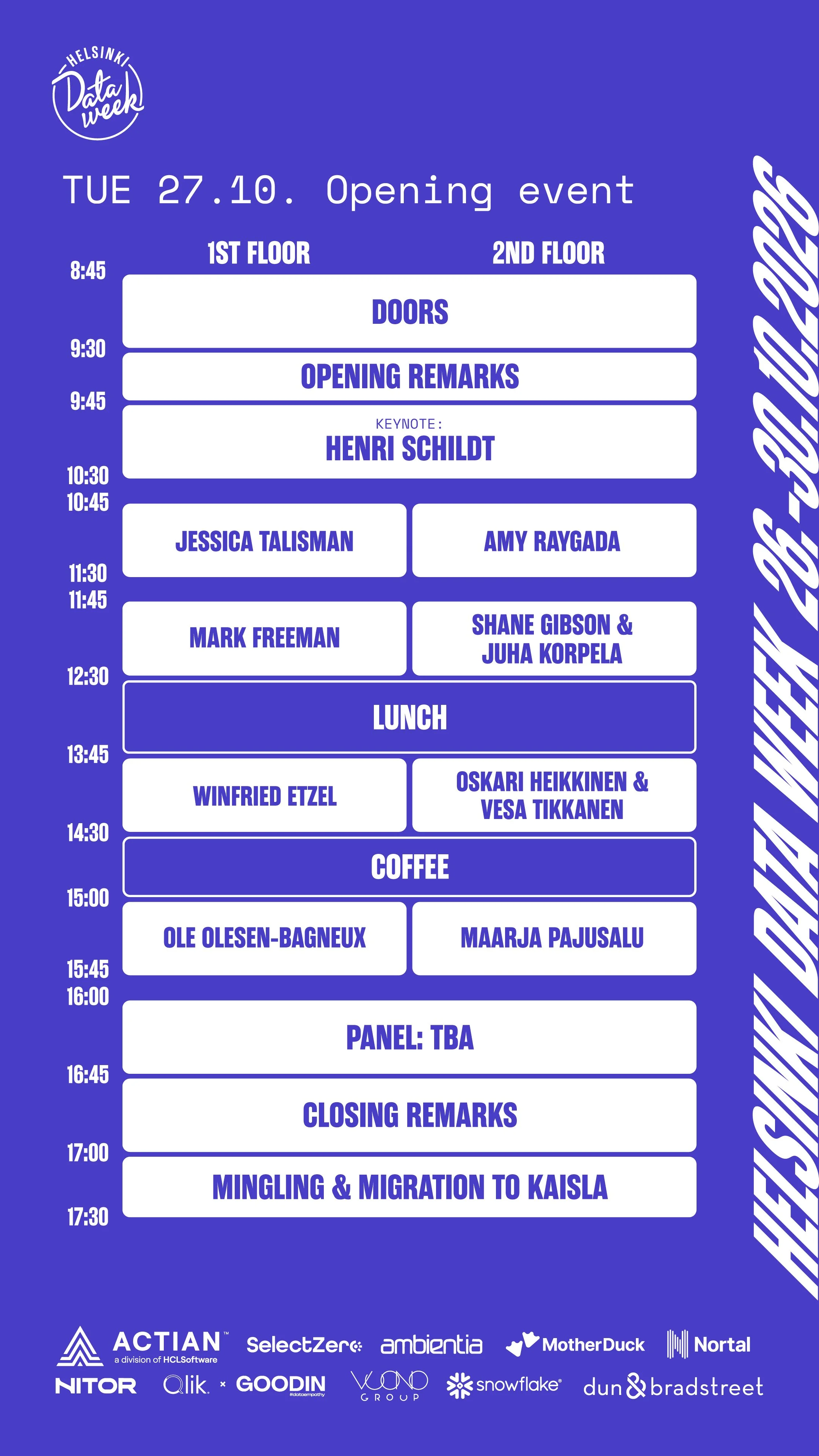
Speakers (and schedule)
Main partner
Actian
Partners
Ambientia
Dun & Bradstreet
MotherDuck
Nitor
Nortal
Qlik x Goodin
SelectZero
Snowflake
Vuono Group
Read more about the partners here!
Price/ticket
Three different prices depending on when you buy
Early bird (from March to May 31) - 75 €
Regular bird (from Jun 1 to Sep 30) - 100 €
Late bird (from Oct 1 to Oct 26, 12 pm (EET)) - 150 €
Note! The price of admission includes lunch
Note! Limited capacity. When the event is sold out, it’s sold out
Get your tickets below!
PS. You can attend all the partner events during the week for free!
Agenda
08:45-09:30
Doors
09:30-09:45
Stage 1
Opening remarks
09:45-10:30
Stage 1
Keynote
Henri Schildt: The World of Meanings and the Unbearable Ambiguity of Text
For decades, data work has meant numbers and categories: clean, countable, and unambiguous. But now algorithmic processing of data is rapidly shifting from numbers and categories to textual data, rich in meaning but also inherently ambiguous. Embedding models, large language models, and new innovations such as Jev enable us to process and ”interpret" text at a scale no research team could match. Interviews, open-ended survey responses, and customer feedback hold valuable knowledge, but even humans do not always agree on what text means.
New opportunities are emerging with textual data, both through qualitative analysis and mixed methods that combine traditional categorical and numeric analyses with meanings inferred from text. This shift has widespread implications for gathering, organizing, and using data. To address this ambiguity of meaning and turn it from a problem into a strength, we need new practices, new expertise, and new infrastructure.
10:45-11:30
Stage 1
Jessica Talisman: Context Graphs, Context Layers, and the Semantic Renaissance
Two engineering traditions are converging on knowledge graphs from opposite ends. Software engineering built the LLM wiki: llms.txt (2024), Karpathy's cross-linked markdown wiki (2026), and Google's Open Knowledge Format (OKF) — curated files written for agents to read.
The data discipline built the semantic layer, which includes governed metrics and entity definitions, now open-sourced through MetricFlow and standardized through the Open Semantic Interchange. In 2025–2026, both communities are reaching for context. VCs positioned the "context graph" around the needs of agentic architectures, publishing the late 2025 context graph article that set LinkedIn on fire; shortly thereafter, semantic layer vendors reframed their work as the "context layer" to benefit agentic architectures. Two disciplines, working independently, are wrestling with how to add machine-readable meaning.
This talk maps the convergence. The LLM wiki supplies readable, versioned context without formal semantics or stable identity. The semantic layer supplies governed definitions without open-world reasoning or linkability. Together, they form a knowledge graph, and RDF — now advancing through 1.2 — is the common ground that lets the two implementations interoperate rather than coexist.
Supported by peer-reviewed research, knowledge graph grounding improves factual reliability, with graph-based retrieval delivering its largest gains on multi-hop reasoning. The convergence opens a renaissance for RDF adoption, driven by two communities reaching for ontology-based implementations from opposite ends. The Semantic Renaissance brings networks of meaning that are elegant, interoperable, and machine-verifiable.
Stage 2
Amy Raygada: The Readiness Illusion: Why Even the Best AI Can’t Fix Bad Data
Ask a leadership team if they’re ready for AI and most hands go up. Ask the same room to define “customer,” and you’ll get three different answers. That contradiction is the readiness illusion, and it’s quietly sinking AI initiatives across every industry.
Only 7% of enterprises say their data is truly ready for AI, yet nearly half believe agentic AI will somehow fix their data problems. Meanwhile, autonomous agents are being deployed onto foundations that can’t support them — and unlike a human analyst, an agent never second-guesses bad data. It just executes, fluently and confidently, at machine speed.
This talk cuts through the hype to the unglamorous truth: AI success depends not on data volume but on encoded meaning. Amy Raygada shares four questions every leader should ask before funding an AI initiative, and a practical path from “readiness illusion” to data that can explain itself.
11:45-12:30
Stage 1
Mark Freeman: Data Contracts in an Agentic Era: When Knowledge Becomes Machine-Readable
LLMs not only make it easier to extract information from unstructured text, but also enable AI agents to act on it. But neither eliminates a familiar challenge: that the people, processes, and business definitions behind the data keep changing. Without deliberate change management, today’s semantic layers risk becoming tomorrow’s semantic swamps– much like how our industry used data lakes.
This talk argues that our understanding of data contracts must expand to protect knowledge infrastructure. Drawing on lessons from his O’Reilly book, Data Contracts: Developing Production-Grade Pipelines at Scale, Mark Freeman explores how these systems provide an architecture that protects semantic meaning and maintains it as the business evolves, especially when more and more workflows are being handed to AI.
Mark introduces a proposal for semantic contracts: applying data contract practices to the metadata that codifies organizational knowledge. By connecting metadata standards with automated validation and change alerts in CI/CD, teams can surface changes before they silently disrupt downstream data platforms and AI agents.
Attendees will leave with a framework for connecting knowledge infrastructure with data engineering’s change-management practices, and a clearer understanding of where data contracts fit within an ever-changing agentic architecture.
Stage 2
Shane Gibson & Juha Korpela: Concept Models, Ontologies, Metric Layers, Graphs - oh my!
Ontologies, semantic layers, metric layers, knowledge graphs, graph databases, context for GenAI. They all promise to capture what an organisation means. Underneath each of them sits something that looks a lot like a Concept Model: the things the organization cares about, how they relate, and what they mean, written in its own language and agreed on by the people who hold the knowledge.
In this fireside discussion, Shane and Juha contrast and connect the Concept Model with each of those approaches, where they overlap, where they don’t, and why it matters more now that GenAI tooling needs context it can trust. Questions welcome; there is time for them at each turn.
12:30-13:45
Lunch
13:45-14:30
Stage 1
Winfried Etzel: From Handover to Hangover - How Organizations Delegate Decisions to Machines and Lose Accountability on the Way
Organizations are automating faster than they can govern. As AI agents take over decisions once owned by people, accountability gets blurred. This presentation examines the structural forces behind this drift: why automation complacency is a law, why an agent's stated rationale records what it did, not why it acted, and why accountability that belongs technically to everyone belongs practically to no one.
The crossing happens gradually. Human decides, machine assists. Machine decides, human reviews. Machine decides, no one notices. The line moves while attention fades.
The argument is blunt: the machine can reason, make decisions, and even act on them, but it cannot be accountable for any of it. From there, the presentation gets practical, anchored in the Data Governance Triad (Negotiation, Direction, Audit) and some practical artifacts you can apply.
What's in it for you?
A clear way to decide what to automate, what to supervise, and what to keep firmly in human hands, without giving up the speed and scale you adopted AI for.
Three key takeaways
Automation does not transfer accountability. A human must own the intent.
The line between delegation and abdication moves gradually. Attention fades over time.
Governance is a design problem, not a policy problem. The answer is not more rules.
Stage 2
Oskari Heikkinen & Vesa Tikkanen: From Cubes to Copilots: The Evolution of Data and Analytics Platforms
14:30-15:00
Coffee
15:00-15:45
Stage 1
Ole Olesen-Bagneux: The Meta Grid, Revisited
In his opening keynote at the first edition of Helsinki Data Week in 2024, Ole Olesen-Bagneux asked the audience whether he should publish his book Fundamentals of Metadata Management.
He was unsure because too many in tech look for smooth answers, not real solutions. The audience said, "Publish!" and he did. Now, two years later, Ole returns to Helsinki Data Week. The question is: How did the book do? This talk revisits the Meta Grid's core ideas.
Stage 2
Maarja Pajusalu: From Default Charts to Decisions and Impact - Dataviz in Action
In her talk, Maarja puts the human reader first. We can use AI to make charts, but we make them for humans.
Starting from four questions the reader asks:
What does it show?
What does it mean?
Is it for me?
What should I do now?
Maarja shows how the same data needs a different view for the expert, the newcomer, and the decision-maker, and which accessibility rules every chart should meet.
16:00-16:45
Stage 1
Panel
TBA
16:45-17:00
Stage 1
Closing remarks
17:00-17:30
Mingling & Migration to Kaisla
17:00-20:00
Low-key Data Meetup
@ Kaisla, Vilhonkatu 4, 00100 Helsinki, Finland